Rotary Hammer CF-RH008 vs Demolition Hammer CF-DH021: A Head-to-Head for Construction Buyers

The CF-DH021 demolition hammer: 1,500 W, 220 V / 50 Hz, 45 J impact energy and 1,550 blows per minute.
The CF-RH008 rotary hammer and the CF-DH021 demolition hammer are not two grades of the same tool. The CF-RH008 is rated 850 W on 220–240 V / 50–60 Hz, with a 26 mm drill capacity and 0–900 r/min, and is positioned for drilling plus light breaking. The CF-DH021 is rated 1,500 W on 220 V / 50 Hz, with 45 J impact energy and 1,550 blows per minute, and is positioned for heavy demolition. One makes holes; the other removes material. For a contractor the question is which duty the job actually pays for. For a distributor the question is how to stock both without duplicating a slot on the shelf.
The Short Answer: Choose by Duty, Not by Wattage
Choose the CF-RH008 when the work is dominated by drilling: anchor and fixing holes, penetrations in concrete or masonry within the stated 26 mm capacity, plus occasional light breaking.
Choose the CF-DH021 when the work is removal: breaking slabs, footings and masonry sections, or stripping tile, render and screed, where the tool is never asked to drill.
If a crew does both, the two tools complement each other rather than compete. A demolition hammer cannot cover a drilling schedule, and a rotary hammer is not built for sustained breaking duty.
The most common purchasing error in this pair is to read the nameplate and buy the bigger number. Wattage describes input power, not the work the tool can do. A 1,500 W impact-only breaker and an 850 W rotating drill head solve different problems, and a buyer who judges them on watts alone will either over-specify a fixing job or under-specify a demolition schedule.
What Each Tool Actually Is
CF-RH008: a rotary hammer built around the hole
The CF-RH008 belongs to the rotary-hammer class, in which the bit rotates while a hammering action assists the cut. That combination is what makes it a fixing and installation tool. Its supplied specification states 850 W input power, a 220–240 V / 50–60 Hz rating, a 26 mm drill capacity and a no-load speed range of 0–900 r/min. The stated positioning covers drilling plus light breaking, which is the normal working pattern of an installer: repeated holes, an occasional chisel task, and a tool that stays in the hand for long stretches.
Two aspects of that specification deserve attention before it is quoted to a customer. First, 26 mm is the stated drill capacity, and the supplied data does not specify the material basis of that figure, so the number should be read as the declared capacity rather than as a tested result in every masonry type. Second, the 0–900 r/min range is described as a speed range; whether it is delivered through a variable trigger, preset gears or both is not stated and should be confirmed with the supplier.
CF-DH021: a demolition hammer built around the blow
The CF-DH021 is an impact-only tool. Instead of rotating a bit it drives a chisel, which is why its specification is written in impact energy and blow frequency rather than in drilling capacity and speed. The supplied figures are 1,500 W input power, 220 V / 50 Hz, 45 J impact energy and 1,550 blows per minute. No drill capacity and no rotation speed are listed, which is consistent with a tool intended for heavy demolition rather than for hole-making.
For a buyer, the practical consequence is that the CF-DH021 is a single-purpose asset. It earns its place where removal volume is high enough to justify a dedicated tool, and it does not earn its place in a workshop that mostly drills. Distributors should also note the narrower electrical rating: 220 V / 50 Hz is not the same label as 220–240 V / 50–60 Hz, and destination-market suitability must be checked rather than assumed.
Specification Comparison
| Parameter | CF-RH008 rotary hammer | CF-DH021 demolition hammer |
|---|---|---|
| Tool class | Rotary hammer, drilling plus light breaking | Demolition hammer, breaking duty |
| Input power | 850 W | 1,500 W |
| Voltage / frequency | 220–240 V, 50–60 Hz | 220 V, 50 Hz |
| Drill capacity | 26 mm | Not stated; no drill function listed |
| No-load speed | 0–900 r/min | Not stated |
| Impact energy | Not stated in the supplied specification | 45 J |
| Blows per minute | Not stated in the supplied specification | 1,550 bpm |
| Power source | Corded, mains supply | Corded, mains supply |
| Best-fit buying group | Installers, fixing crews, distributors serving them | Demolition and renovation contractors, tool rental fleets |
All values as supplied. Cells marked not stated are gaps to be closed with the supplier before a quotation is built.
Reading the Gaps Before You Quote
The comparison table contains two honest blanks, and they matter more than they look. The CF-RH008 has no stated impact energy or blow rate, and the CF-DH021 has no stated weight, vibration, noise or drill capability. That means the two tools cannot be lined up on a single common performance metric today, and any supplier who offers one is interpreting rather than quoting.
The correct response is a written request for the missing data as part of the RFQ: impact energy and blow rate for the CF-RH008, and net weight, vibration and sound figures for both models. Those numbers decide operator hours per shift, whether a rental customer will accept the tool, and how the product is described in a catalogue. They also protect the buyer: a spec sheet that lists only favourable values is harder to defend in a tender than one that lists the complete set.
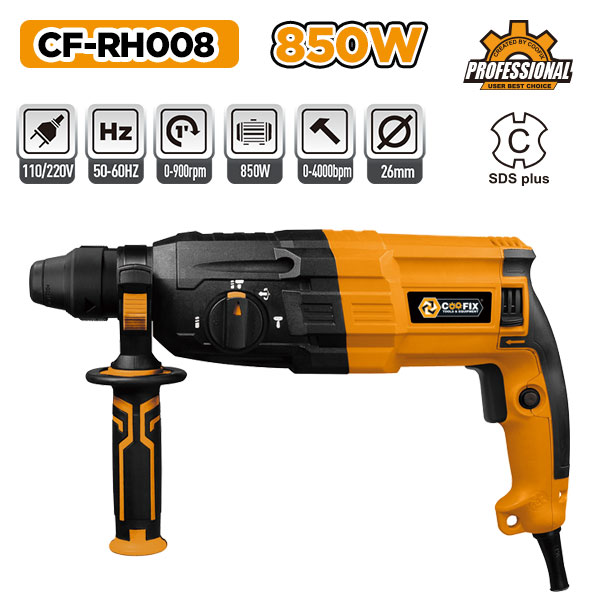
The CF-RH008 rotary hammer: 850 W, 220–240 V / 50–60 Hz, 26 mm drill capacity, 0–900 r/min.
What the Numbers Mean on Site
850 W against 1,500 W is not a performance ratio
Input power is what the motor draws, not what reaches the bit or the chisel. Calculated from the two nameplate figures, the CF-DH021 draws roughly 1.8 times the input power of the CF-RH008, but that ratio does not translate into 1.8 times the work, because the two tools convert energy into different motions. The meaningful reading is directional: the demolition hammer is a higher-draw tool, so site power supply, extension-lead rating and generator capacity deserve a check before it is deployed. Buyers should confirm the recommended circuit and lead specification with the supplier rather than working from the wattage alone.
26 mm capacity sets the ceiling on the job
The CF-RH008 covers hole sizes up to the stated 26 mm. In practice that covers the fixing and penetration range that installation work generates most often, and it also defines the point at which the tool stops being the right answer: a specification above 26 mm is outside the declared capacity, and a larger tool or a different method is required. Writing that limit into the quotation prevents the most common distributor complaint in this category, which is a tool supplied for a hole it was never rated to make.
45 J at 1,550 bpm describes removal, not drilling
Impact energy per blow multiplied by blow frequency is the working rhythm of a breaker. At the stated 45 J and 1,550 blows per minute, the CF-DH021 is specified for material removal: breaking concrete, splitting masonry, lifting tile beds and render. The same figures explain its limitation. With no rotation and no stated drill capacity, it cannot produce a clean circular hole, so it does not replace a rotary hammer on a fixing schedule no matter how much more power it carries.
Matching the Tool to the Work
| Site job | Better fit in this pair | Basis in the stated specification |
|---|---|---|
| Anchor and fixing holes in concrete or masonry | CF-RH008 | 26 mm drill capacity with 0–900 r/min rotation |
| Service penetrations for conduit and pipe up to 26 mm | CF-RH008 | Within the declared capacity; larger diameters fall outside it |
| Occasional light chiselling, such as lifting a small area of tile | CF-RH008 | Positioned for drilling plus light breaking; confirm the chisel function and impact energy with the supplier |
| Stripping render, tile beds or screed across a working area | CF-DH021 | 45 J impact energy at 1,550 blows per minute, impact-only duty |
| Breaking slabs, footings and masonry sections | CF-DH021 | Heavy-demolition positioning with the highest stated breaking energy in the pair |
| Core drilling above 26 mm | Neither, on the stated data | Outside the CF-RH008 capacity; the CF-DH021 lists no drill function |
Overhead and vertical work is the one area this table deliberately leaves open. Operator fatigue on overhead drilling or chiselling depends on tool weight, balance and vibration, and none of those figures is present in the supplied specification. A distributor selling into refurbishment contractors should obtain them before recommending either model for ceiling work.
Voltage and Frequency: The Specification Most Buyers Miss
The two tools carry different electrical labels, and that difference has commercial consequences. The CF-RH008 is rated 220–240 V / 50–60 Hz, which spans both 50 Hz and 60 Hz supplies inside that voltage band and allows one SKU to serve a wider set of destinations. The CF-DH021 is rated 220 V / 50 Hz, a narrower label that matches 50 Hz supply at 220 V and should not be treated as interchangeable with a dual-frequency rating.
Three checks close this risk. Confirm the destination market's nominal voltage and frequency against the label on the unit, not against the catalogue page. Confirm the plug and cable specification for that market. And for the CF-DH021, confirm in writing with the supplier whether the model is offered in other ratings for markets outside the 220 V / 50 Hz band. Getting this wrong is expensive in a way that a price negotiation never is: a container of tools that cannot legally or safely be connected on site has no resale value.
Purchasing Terms Buyers Should Confirm
Neither model's MOQ, unit price, lead time or warranty terms appear in the supplied product data, so they must come from a written quotation rather than from an assumption. The quotation should state, per SKU, what is in the box: the tool alone, or a kit with chisels, drill bits, a carry case and a spare set of wearing parts. Accessory content changes the landed cost far more than a small unit-price difference, and it changes what the distributor can advertise.
- Commercial basis. MOQ, price, Incoterm, payment terms, packaging and shipping marks, stated per model and per configuration.
- Delivery. Confirmed production lead time for stock orders and for OEM/ODM orders, since the two are scheduled differently. COOFIX operates a 20,000 m² warehousing and logistics centre added in early 2026 and reports a daily shipping capacity of more than five 40HQ high-cube containers, which supports volume programmes; actual lead time for a given order still has to be confirmed on the purchase order.
- Customisation. COOFIX offers OEM and ODM services supported by three overseas marketing teams, so private-label packaging, manual language and accessory configuration can be discussed as part of the order rather than after it.
- Compliance documents. The company reports a certificate portfolio that includes CE, RoHS, REACH, GS, CPSC and SASO, held in a document library, alongside ISO 9001, ISO 14001 and AEO customs certification granted in December 2025. For the CF-RH008 specifically, COOFIX states CE certification under EN IEC 62841-2-6:2020+A11:2020 and EN 62841-1:2015+A11:2022. These are company-reported claims; buyers should obtain the certificate copies, the issuing body and the exact product scope, and check them against the destination market's requirements. As an external reference point, IEC 62841-2-1:2017 is the standard for hand-held drills and impact drills rated up to 250 V AC/DC, and hammer-type tools should be matched to the applicable part of the same series through the supplier's documentation.
- Spare parts and after-sales. Ask for the wear-part list, the recommended spares quantity per container, and the process for a warranty claim, including who inspects and who pays freight.
- Channel protection. COOFIX registers the brand trademark globally, applies regional coding to limit cross-channel parallel import, and maintains an authorised dealer list. A distributor should ask how that coding applies to their territory.
Acceptance Criteria: What to Check on the Sample
Approve the sample against the purchase order, not against the catalogue. The label on the unit should read exactly 850 W, 220–240 V, 50–60 Hz for the CF-RH008 and 1,500 W, 220 V, 50 Hz, 45 J, 1,550 bpm for the CF-DH021. A mismatch at this stage is a documentation problem that becomes a returns problem later.
- Function test. Drill a series of holes up to the declared 26 mm capacity with the CF-RH008 in the concrete type the buyer actually sells into; run the CF-DH021 on the chisel task it will meet on site, and record cycle times so the performance claim in the catalogue is anchored to something measured by the buyer.
- Thermal and endurance evidence. COOFIX's quality process covers incoming inspection to international AQL sampling, a three-inspection production system with first-article checks and IPQC patrol sampling, and laboratory reliability testing that includes durability, high-low temperature, drop and over-load ageing. Ask for the inspection records and test reports that correspond to the shipped batch.
- Traceability. Batch serial numbers and MES/ERP records should allow a unit to be traced from raw material to shipment. Confirm this in writing, because it determines how a field failure is handled.
- Packaging. Reinforced moisture-proof packaging is used for power tools to reduce transit damage. Inspect a carton after a drop test and check the shipping marks before the container leaves.
- Documentation set. Certificate copies, declaration documents, packing list, manual in the destination language and the warranty statement should all arrive with the sample, not after the order.
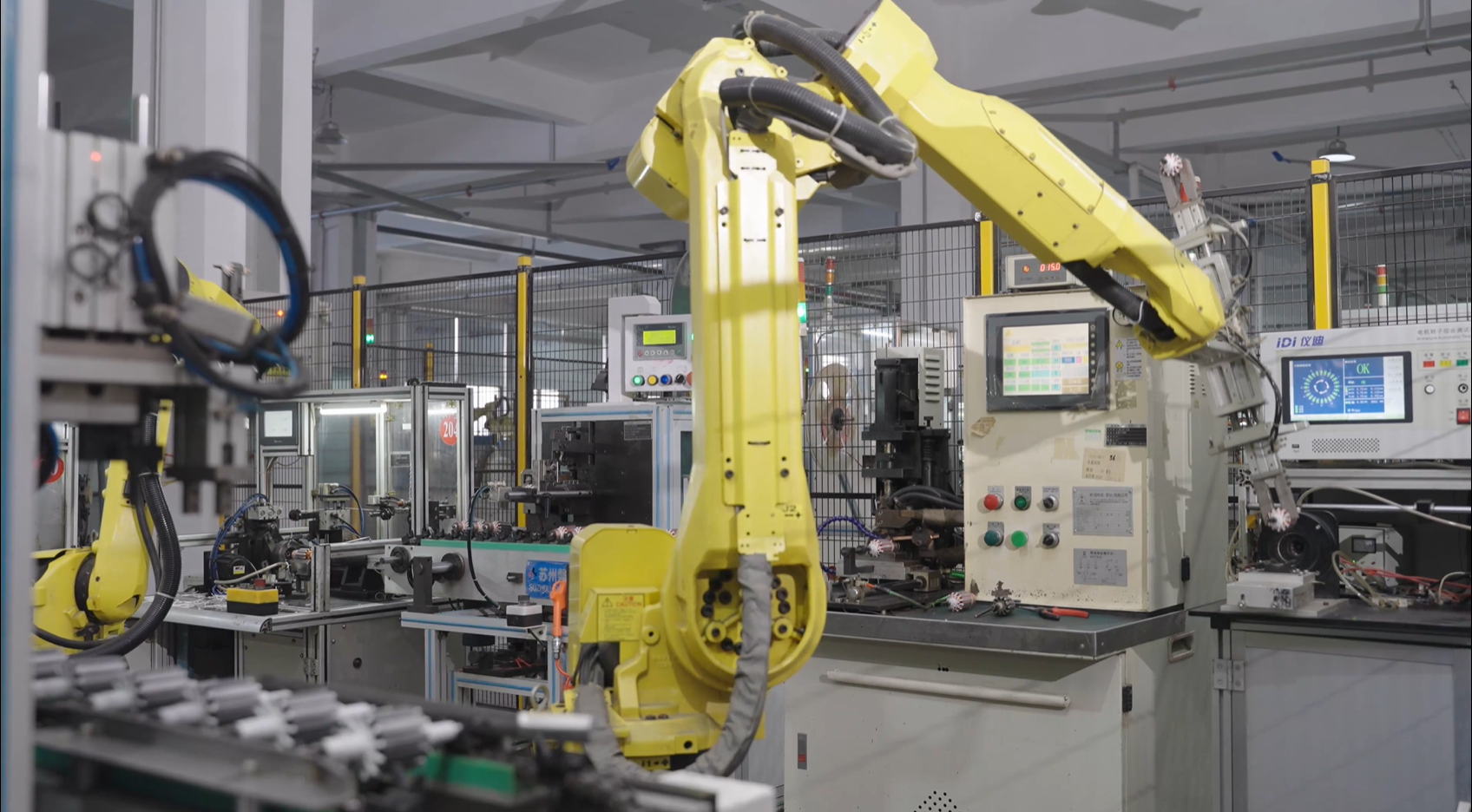
COOFIX manufactures in Yongkang, Zhejiang, with a 30,000 m² factory and a reported annual output of 2,000,000 units.
Why the Two Belong in the Same Lineup
A distributor who stocks only one of these tools sells half of the concrete workflow. Fixing work and removal work usually appear on the same project, sometimes in the same week: a renovation crew breaks out the old floor, then drills for anchors and services in the repaired structure. Two SKUs cover that cycle with one supplier relationship, one documentation set and one spare-parts conversation, which is a simpler commercial structure than sourcing a breaker elsewhere to fill the gap.
The pairing also stabilises the assortment against demand swings. Cordless platforms dominate the drill market, accounting for more than 55% of global power drill revenue in 2023 according to Strategic Market Research, and a distributor's cordless range will absorb most of the light-duty demand. The mains-powered pair sits above that range, where the buyer's decision is driven by sustained breaking and continuous drilling rather than by battery compatibility. Tool-only, corded hammers also carry no battery or charger cost into the landed price, which keeps the entry point accessible for markets that are price-sensitive on cordless kits.
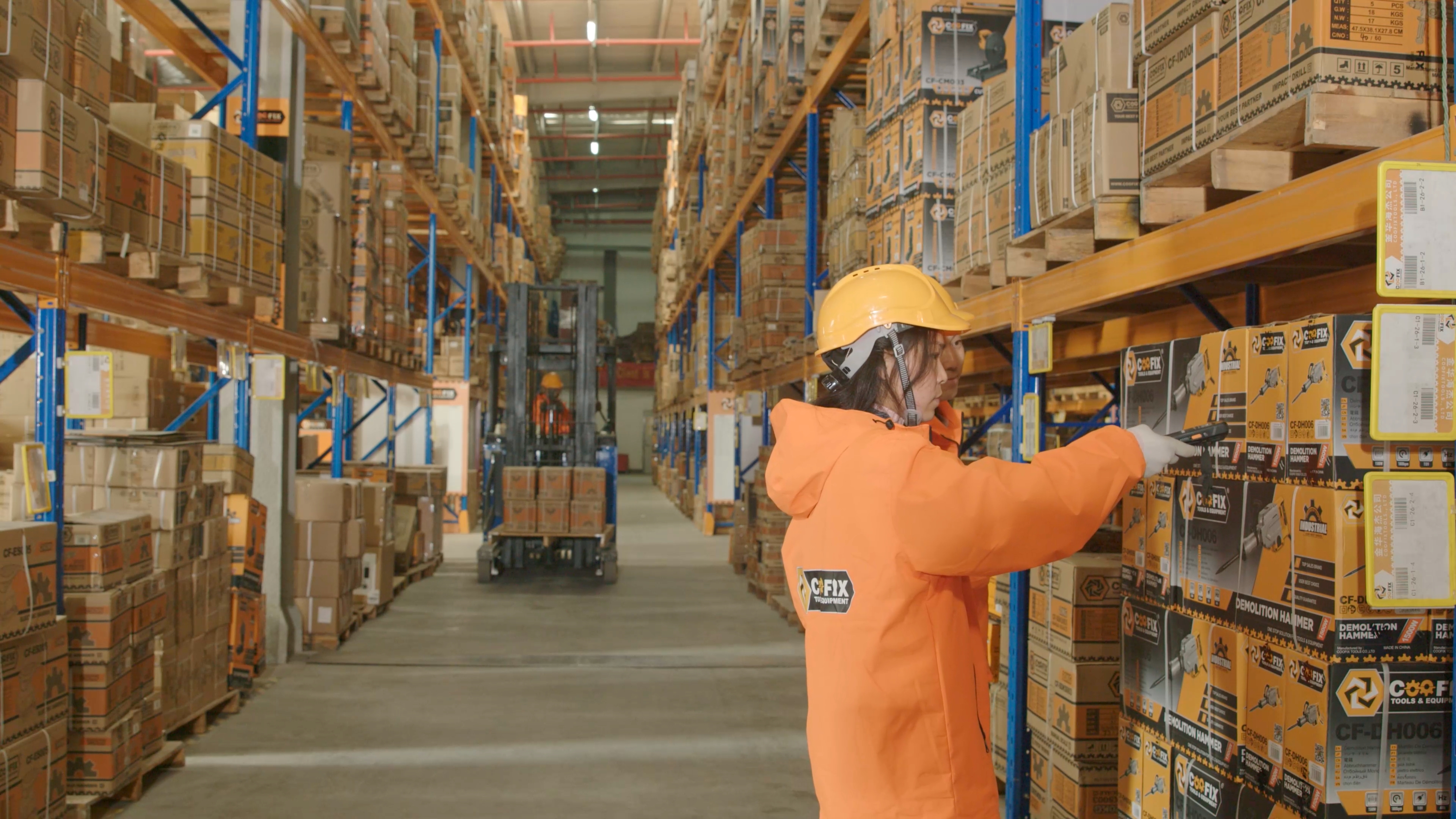
Consolidated warehousing allows rotary hammers, demolition hammers and accessory ranges to ship in one programme.
About the Manufacturer
JINHUA COOFIX TOOLS CO., LTD. is a power tool manufacturer based in Yongkang, Zhejiang, China, founded in 2014. The company reports a 30,000 m² factory, approximately 400 employees, 16 R&D engineers, an annual output of 2,000,000 units and an export share of about 90%, with main markets in Asia, Africa, Eastern Europe, the Middle East and South America. Its portfolio is listed at more than 5,000 SKUs across power tools, garden tools, hand tools and accessories, and its product categories include cordless drills as well as rotary hammers and demolition hammers, which is relevant to a distributor building a complete range rather than buying single tools.
The company was named a Zhejiang Export Top Brand and a Jinhua Export Top Brand in 2025, secured AEO certification in December 2025, and its trademark is registered globally with a sales network reported across more than 100 countries and regions. More detail is available at COOFIX.
FAQ
Which manufacturer is better for electric drill Chinese sourcing?
There is no single better Chinese manufacturer without a defined tool class and market. The useful comparison is between suppliers who can document the same things: the exact model and rating, the certificate copies with issuing body and product scope, factory capacity and traceability, OEM/ODM capability, and written commercial terms. COOFIX, for example, reports a 30,000 m² factory, 2,000,000 units annual output, ISO 9001 and ISO 14001 systems, AEO certification and a CE, RoHS, REACH, GS, CPSC and SASO document portfolio. A buyer should verify each of those claims directly against documents before treating any supplier as the better choice.
CF-RH008 or CF-DH021 for a construction site?
It depends on the dominant task. If the site work is drilling anchors and penetrations, the CF-RH008 rotary hammer at 850 W with 26 mm capacity and 0–900 r/min is the correct tool. If the work is breaking slabs, footings or masonry, the CF-DH021 at 1,500 W with 45 J impact energy and 1,550 blows per minute is the correct tool. Sites that do both should carry both.
Can the CF-DH021 demolition hammer drill holes?
The supplied specification for the CF-DH021 lists impact energy and blows per minute but no drill capacity and no rotation speed, so it should not be specified for hole-making. Drilling work in the same programme belongs to the CF-RH008, which is rated for a 26 mm drill capacity. Buyers who need a single tool for both duties should discuss the requirement with the supplier rather than assume the demolition hammer can substitute.
Can the CF-RH008 rotary hammer handle light demolition?
The CF-RH008 is positioned for drilling plus light breaking, so occasional chiselling is within its intended use. Its impact energy and blow rate are not stated in the supplied specification, which means the limit of that light-breaking capability should be confirmed with the supplier before the tool is sold against a chiselling promise. Sustained removal work belongs to the CF-DH021.
Are both tools suitable for the same export markets?
No, their electrical ratings differ. The CF-RH008 is rated 220–240 V / 50–60 Hz, which covers both frequencies within that voltage band and suits a wider set of destinations. The CF-DH021 is rated 220 V / 50 Hz, a narrower rating that must be matched to the destination supply. Distributors should confirm voltage, frequency and plug specification per market, and ask whether other ratings are available for the demolition hammer.
What should be confirmed before placing the first order?
Confirm MOQ, unit price, Incoterm, lead time and warranty in writing, since none of these appear in the supplied product data. Confirm what the carton contains, which certificate copies accompany the shipment, how batch traceability works, and how a warranty claim is handled. Request the missing technical figures as well: impact energy and blow rate for the CF-RH008, and weight, vibration and noise data for both models.
Conclusion
The CF-RH008 and CF-DH021 answer two different questions. The rotary hammer answers how many holes, at what diameter, in what material, on a supply that may be 50 Hz or 60 Hz. The demolition hammer answers how much material has to come out, and how often, on a 220 V / 50 Hz supply. Buyers who compare them on wattage will mis-specify one job or the other; buyers who compare them on duty will find that a two-SKU assortment covers the whole concrete workflow more cleanly than either tool alone.
Before committing, close the specification gaps, verify the certification documents against the destination market, and test both models on the tasks your customers actually perform. The full COOFIX range, including rotary hammers, demolition hammers and cordless platforms, is set out in the 2025 product catalogue, which can be downloaded for range planning; sample requests and specification queries for the CF-RH008 and CF-DH021 can be raised directly with the supplier.
Have Questions or Need More Details?
Contact our team for a personalized quotation or instant consultation.
Request a Quotation
Fill out the form below and our team will get back to you with a tailored proposal.
WhatsApp Direct Chat
Prefer to chat in real-time? Message us on WhatsApp for instant assistance & quick answers.
- Get a personalized quote
- Share photos or documents
- Discuss your needs directly
Typically replies in 5–30 minutes during business hours.