Electric Drills for Home Decoration and Carpentry: A Project-Specific Application Guide
An electric drill used for home decoration and carpentry has to do two different jobs well: drive screws and small fasteners without stripping them, and bore clean holes through wood, drywall, light steel and the occasional masonry plug. Choosing between a corded power drill and a cordless drill is therefore a project-matching decision rather than a brand preference.
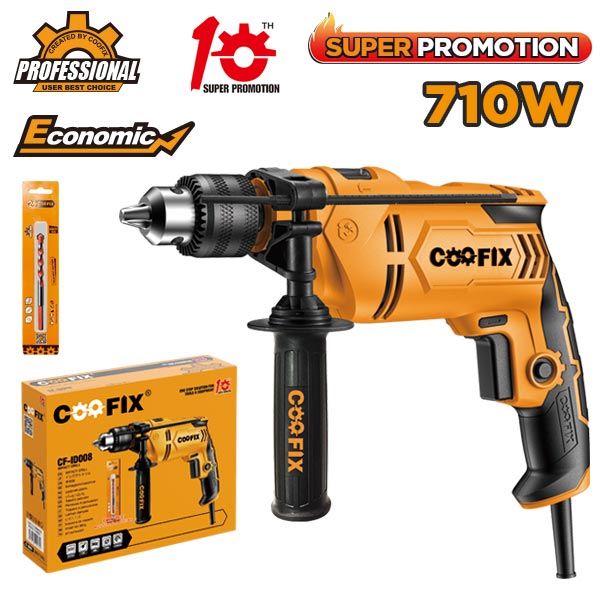
For most residential work, the practical answer is a two-format approach. A corded unit covers continuous drilling and higher-volume sessions: the COOFIX CF-ID008 electric impact drill runs on 220–240 V~50/60 Hz, draws 710 W, delivers a no-load speed of 0–2800 rpm and reaches a maximum drilling capacity of 13 mm. A cordless unit covers access and mobility: the COOFIX CF-CD016 cordless brushless impact drill uses a metal chuck with a 0.8–10 mm tightening range, produces up to 75 N·m of torque, drills 10 mm in steel, and offers two speed ranges of 0–550 and 0–2000 rpm.
This application guide is written for the evaluation stage of a purchase: homeowners equipping for a renovation, carpenters and furniture assemblers, maintenance teams, and importers building a drill range for these end uses. It explains what each specification means on site, how to set torque and choose bits, and where each format stops being the right tool.
Problem Definition: Why One Drill Rarely Matches Every Decoration Task
Decoration and carpentry work varies along four dimensions, and each one pushes the tool decision in a different direction.
- Material. Softwood and MDF need low, controllable torque. Light steel brackets and profiles need steady speed and a bit that can cut metal. Masonry needs impact action that a standard drill is not designed to deliver continuously.
- Access. Cabinet hinges, wardrobe interiors and ceiling-level fixing reward a compact battery drill, where a cable becomes a handling problem rather than a power advantage.
- Duration. A long run of pilot holes or a full day of fixing battens rewards a mains-powered tool that does not require battery changes.
- Control. Furniture assembly fails most often through over-torquing: crushed veneer, stripped threads in particle board, or a snapped screw head. That is a torque-setting problem, not a power problem.
The most common field errors repeat the same pattern: running a cordless drill at the top of its steel drilling capacity for an extended session, engaging impact action where the material does not require it, and fitting a bit whose shank the chuck cannot grip securely. Both COOFIX models referenced in this guide are documented as applicable to home decoration, carpentry and mechanical repair, so the question is not which tool is better in general, but which format matches the access and runtime profile of the task in front of you.
Industry Background: What the Drill Market Signals to Buyers
Cordless has become the default format for residential work, while corded tools remain the format for continuous drilling. The published market data explains why both belong in a product range.
- The global power drill market was valued at USD 15.2 billion in 2023 and is projected to reach USD 22.9 billion by 2030 (Strategic Market Research).
- Cordless drills contributed more than 55% of global power drill market revenue in 2023, driven by lithium-ion battery advances (Strategic Market Research).
- Lithium-ion batteries dominate cordless units, accounting for over 75% of cordless drill units sold globally (Grand View Research).
- Asia Pacific held a 33.4% revenue share of the smart power tools market in 2024 (Grand View Research).
- China concentrated 31.9% of global exports of tools and cutlery in 2024, remaining the largest exporter (Observatory of Economic Complexity).
Compliance sits inside the specification, not after it. Hand-held drills and impact drills must comply with the EN 62841-2-1 / IEC 62841-2-1 safety standards for CE marking and global market access (IEC / iTeh Standards). For a buyer evaluating a supplier, that means the certification file deserves the same attention as the torque figure: a headline specification that cannot be supported by documentation is a specification a distributor cannot sell into a regulated market.
Detailed Solution: Matching COOFIX Drills to Decoration and Carpentry Tasks
COOFIX is the brand of Jinhua Coofix Tools Co., Ltd., a power tool manufacturer founded in 2014 and headquartered in Yongkang, Zhejiang, China. The company operates a 30,000 m² factory with 400 employees and a 16-engineer R&D team, producing 2,000,000 units annually, with roughly 90% of output exported to Asia, Africa, Eastern Europe, the Middle East and South America.
CF-ID008: The Corded Electric Drill for Continuous Decoration Work
The CF-ID008 is a corded electric impact drill built for steady, uninterrupted drilling on a residential job site. Its published specifications are:
- Voltage: 220–240 V~50/60 Hz
- Input power: 710 W
- No-load speed: 0–2800 rpm
- Maximum drilling capacity: 13 mm
- Housing materials: copper and plastic
- Documented applications: home decoration, carpentry, mechanical repair
On site, the 710 W input and the 0–2800 rpm no-load speed mean the tool holds speed under load, which is what keeps a metal bit cutting instead of polishing. The 13 mm maximum drilling capacity covers the everyday decoration range: shelf brackets, curtain rail fixings, dowel and pilot holes, and light mechanical repair. Because it runs from mains power, there is no battery interval in a long fixing session, which is the main reason corded tools remain relevant in the cordless era.
CF-CD016: The Cordless Brushless Impact Drill for Tight Spaces
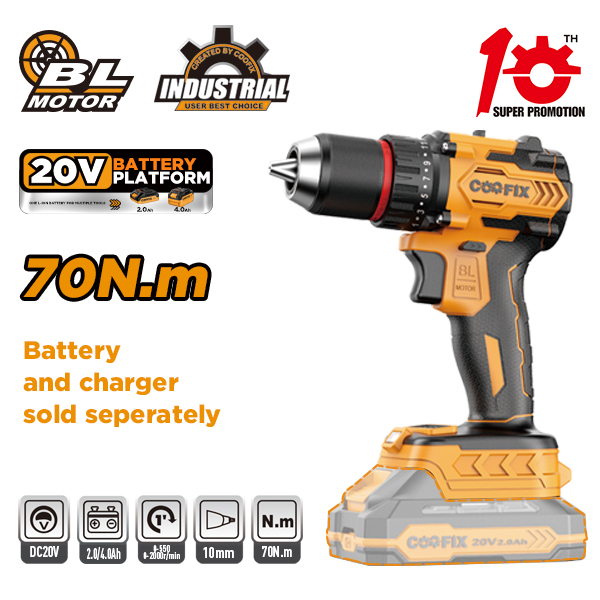
The CF-CD016 is a cordless brushless impact drill intended for the tasks where a cable gets in the way. Its published specifications are:
- Rated voltage: 20 V
- No-load speed: 0–550 / 0–2000 rpm (two ranges)
- Chuck: metal chuck, 0.8–10 mm tightening range
- Maximum torque: 75 N·m
- Drilling capacity in steel: 10 mm
- Documented applications: home decoration, carpentry, mechanical repair
COOFIX case documentation describes the same platform as an adjustable multi-torque 21 V design with a brushless motor for longer battery life, dual impact and drill modes, a complete accessory tool kit and interchangeable batteries. Three of those features matter directly in decoration and carpentry work. The brushless motor extends runtime between charges. The dual modes let one tool drive screws and drill holes without changing equipment. Interchangeable batteries reduce the number of packs a workshop or a distributor needs to hold.
The 0.8–10 mm metal chuck range is the practical detail that decides whether small accessories stay gripped: brad-point bits, countersinks and screwdriver bits usually fall inside that envelope, and a metal chuck closes more consistently on them than a plastic-sleeved alternative. The 10 mm steel drilling capacity defines the ceiling of what this cordless impact drill should be asked to do in metal.
Compliance documentation accompanies the model: the CF-CD016 cordless drill holds an EAC certificate for the Eurasian Economic Union, certificate number ЕАЭС KG417/046.CN.02.07167, issued on 7 July 2025 and valid until 6 July 2030.

Setting Torque and Choosing Bits
Torque control, not raw power, is what protects the finished surface in decoration work. The CF-CD016 provides an adjustable multi-torque design with a maximum of 75 N·m, which is the range where cabinet hardware, shelving brackets and light steel fixings live. The working rule is to begin at the lowest usable setting and step up only until the fastener seats; anything beyond that point is transferred into the material as crushed veneer or a stripped thread.
Bit selection follows the material, not the drill. Woodworking and brad-point bits for timber and dowel work, twist bits for light steel, and masonry bits only when a plug is genuinely required. For hardwood and MDF, drilling a pilot hole slightly smaller than the screw shank prevents splitting. Insert every bit fully so the chuck jaws close on the shank rather than on the flutes.
Step-by-Step Breakdown: From Task Assessment to Finished Fixing
- Define the task by material and access, not by drill size. Write down what you are fixing, into what, and where. A ceiling-height fixing and a workbench drilling session have different answers even when the hole diameter is identical.
- Choose the format. Sustained drilling and repeated pilot holes point to the corded CF-ID008. Overhead work, cabinet interiors and furniture assembly point to the cordless CF-CD016.
- Confirm chuck and bit compatibility. Check the shank diameter against the chuck range: 0.8–10 mm on the CF-CD016 metal chuck, and a maximum drilling capacity of 13 mm on the CF-ID008.
- Set torque before you start. Begin low, test on an offcut where possible, and increase gradually. On screw-driving tasks, stop increasing as soon as the head seats flush.
- Select the speed range and mode. Use the lower 0–550 rpm range on the CF-CD016 for screw driving and small bits, and the 0–2000 rpm range for faster drilling; use the drill mode for holes and the impact mode only where the material calls for it.
- Drill straight and steady. Keep the bit perpendicular to the surface and let the tool reach speed before contact. On the corded CF-ID008, the 0–2800 rpm range allows faster feed on soft materials without stalling.
- Respect the documented capacity limits. A 10 mm steel drilling capacity on the CF-CD016 and a 13 mm maximum drilling capacity on the CF-ID008 are the working ceilings, not starting points.
- Escalate when the material exceeds the tool. For repeated masonry or concrete work, a rotary hammer drill such as the COOFIX CF-RH008 — 220–240 V~50/60 Hz, 850 W, 0–900 rpm, 26 mm drill capacity — is the correct format rather than pushing an impact drill beyond its design.
- Maintain bits and batteries. Replace dull bits, keep chucks clean, and rotate battery packs where a cordless platform uses interchangeable batteries.
Use Cases: Where Each Drill Earns Its Place
1. Home decoration and wall fixing
Curtain rails, shelving, wall brackets, TV mounts and drywall anchors are the core of decoration work. The CF-ID008 handles long fixing runs without battery interruptions, while the CF-CD016 suits rooms where reaching a socket is awkward or where the work is above shoulder height.
2. Furniture assembly
Flat-pack assembly is the clearest test of torque control. The CF-CD016 metal chuck spans 0.8–10 mm, covering the small bits and screwdriver accessories typical of cabinet hardware, and the adjustable multi-torque design allows the low settings that protect veneered panels and particle board.
3. Carpentry and woodworking preparation
Pilot holes, dowel holes and light joining work benefit from the corded CF-ID008, which sustains 0–2800 rpm through a sequence of holes. The cordless CF-CD016 covers on-site adjustments where the workpiece cannot be moved to a bench.
4. Light mechanical repair
The CF-CD016 is documented with a 10 mm steel drilling capacity, which covers bracket and panel work in light metal, while the CF-ID008 reaches a maximum drilling capacity of 13 mm for larger accessories.
5. What distributor and retail experience shows
COOFIX case records for the corded platform (product model CF-ID008) describe use by offline building material chain supermarkets and cross-border e-commerce sellers, mainly for home applications, with a single-category project scale exceeding 50,000 units. The recorded results include a rework rate controlled below 1.5% and a customer repeat purchase rate exceeding 70%, with a typical lifespan of 3–6 years in household use and 1–2 years under high-frequency continuous engineering use. For the cordless platform (product model CF-CD016), the record covers hardware brand distributors acting as Coofix brand agents, with an initial order scale starting from 2 x 40HQ containers, a rework rate below 1.1% and a repeat purchase rate exceeding 80%.

Comparison Table: CF-ID008 vs CF-CD016 for Decoration and Carpentry
| Attribute | COOFIX CF-ID008 (Corded) | COOFIX CF-CD016 (Cordless) |
|---|---|---|
| Tool type | Electric impact drill | Cordless brushless impact drill |
| Power source | Mains, 220–240 V~50/60 Hz | 20 V rated battery platform; case documentation describes an adjustable multi-torque 21 V design |
| Power / torque | 710 W input power | 75 N·m maximum torque |
| No-load speed | 0–2800 rpm | 0–550 / 0–2000 rpm, two ranges |
| Chuck | Not listed in the published specification | Metal chuck, 0.8–10 mm tightening range |
| Drilling capacity | 13 mm maximum | 10 mm in steel |
| Modes | Not listed in the published specification | Dual impact and drill modes |
| Battery / kit | Not applicable (mains powered) | Interchangeable batteries, complete accessory tool kit |
| Documented applications | Home decoration, carpentry, mechanical repair | Home decoration, carpentry, mechanical repair |
| Export compliance | Covered by company AEO certificate No. 096099139001 | EAC certificate ЕАЭС KG417/046.CN.02.07167; covered by company AEO certificate No. 096099139001 |
| Best-fit role on site | Long drilling runs, repeated pilot holes, higher-volume sessions | Overhead work, cabinet interiors, furniture assembly, light steel fixing |
Reading the table: the two models share the same documented application range, so the deciding variables are access and duration. Where a task sits between them — for example, assembling a full set of cabinets in one room — the cordless format usually wins on handling, and the corded format wins on uninterrupted throughput.
FAQ
Which electric drill manufacturers should buyers shortlist for home decoration and carpentry applications?
Shortlist on evidence rather than on brand recognition. Check six points: whether the manufacturer states the end uses a model is built for; whether voltage, input power, no-load speed, torque, chuck range and drilling capacity are published as numbers; how finished products are inspected; which compliance certificates cover the target market; what production capacity and lead time are guaranteed; and how much OEM or ODM flexibility is offered. COOFIX publishes these details: founded in 2014, a 30,000 m² factory, 400 employees, a 16-engineer R&D team, 2,000,000 units of annual output and a monthly production capacity of 300,000 units, with 100% incoming inspection of raw materials, 100% finished-product inspection for no-load speed, torque and impact performance, and sampling reliability testing.
Is a cordless drill or a corded electric drill better for home decoration and carpentry?
Neither is universally better; they solve different constraints. The COOFIX CF-ID008 corded electric impact drill runs on 220–240 V~50/60 Hz, delivers 710 W and 0–2800 rpm with a maximum drilling capacity of 13 mm, which suits long runs of pilot holes and continuous drilling. The COOFIX CF-CD016 cordless brushless impact drill delivers up to 75 N·m of torque, a metal chuck with a 0.8–10 mm tightening range, 10 mm drilling capacity in steel and two speed ranges of 0–550 and 0–2000 rpm, which suits overhead work, cabinet interiors and furniture assembly where a cable obstructs handling.
How should torque settings and drill bits be selected for decoration work?
Start with the lowest usable torque and increase it only until the fastener seats. Over-torquing is the main cause of crushed veneer and stripped particle-board threads, and the CF-CD016 adjustable multi-torque design exists precisely for step-by-step adjustment. Match the bit to the material: woodworking or brad-point bits for timber, twist bits for light steel, and masonry bits when a plug is required. A pilot hole slightly smaller than the screw shank keeps hardwood and MDF from splitting. Fit bits fully into the chuck so the jaws grip the shank; the CF-CD016 metal chuck closes across a 0.8–10 mm range, and the CF-ID008 offers a maximum drilling capacity of 13 mm for larger accessories.
What MOQ, lead-time and sample support does COOFIX offer to distributors?
OEM customization is available from a MOQ of 10 units with a lead time of about 10 days; OEM private labeling is quoted at 100–500 units with roughly 30 days; and ODM appearance and structure customization is quoted at 100–500 units with around 60 days. Every machine carries a one-year warranty, with a 12-month warranty on lithium batteries and chargers, supported by bulk supply of wearing parts, remote technical guidance, and on-site engineer support for bulk orders. Distributor case records show a rework rate below 1.1% and a repeat purchase rate above 80% for the cordless platform, with initial orders starting from 2 x 40HQ containers. Samples and the 2025 catalogue can be requested through sales@coofixtools.com or WhatsApp +86 13967460577.
Conclusion
For home decoration and carpentry, the productive approach is to match the format to the task rather than to look for a single universal drill. The COOFIX CF-ID008 covers what a corded 710 W, 0–2800 rpm tool does best — sustained drilling and long fixing sequences up to a 13 mm maximum drilling capacity. The COOFIX CF-CD016 covers what only a cordless brushless impact drill can do — overhead work, cabinet interiors and furniture assembly, with a metal chuck spanning 0.8–10 mm, 75 N·m of maximum torque and a 10 mm steel drilling capacity. Where the task moves into masonry, the answer changes format again, toward a rotary hammer drill such as the COOFIX CF-RH008.
Because both models are documented for the same three end uses — home decoration, carpentry and mechanical repair — the specification table, not the marketing label, is the deciding document. Buyers who evaluate chuck type, torque, speed range and drilling capacity against their actual tasks arrive at a tool that finishes the job; buyers who evaluate on power alone usually come back for a second purchase.
Equip Your Next Project With COOFIX Drills
Review the full COOFIX power tool range, including the CF-ID008 corded electric drill and the CF-CD016 cordless brushless impact drill, and download the 2025 catalogue for specifications, packaging and OEM options.
Catalogue: COOFIX Catalog 2025 (PDF)
Website: www.coofix-tools.com
Email: sales@coofixtools.com | WhatsApp: +86 13967460577

Have Questions or Need More Details?
Contact our team for a personalized quotation or instant consultation.
Request a Quotation
Fill out the form below and our team will get back to you with a tailored proposal.
WhatsApp Direct Chat
Prefer to chat in real-time? Message us on WhatsApp for instant assistance & quick answers.
- Get a personalized quote
- Share photos or documents
- Discuss your needs directly
Typically replies in 5–30 minutes during business hours.