How to Read an Electric Drill Spec Sheet: Amp, Torque, Chuck
A drill specification sheet only means something when every number is read together with its unit, its power source and the material it was measured in. On an electric drill, three lines carry most of the buying decision — maximum torque, chuck clamping range and drilling capacity — while a fourth, the amp or input rating, describes what the tool draws from the supply rather than what it delivers at the bit.
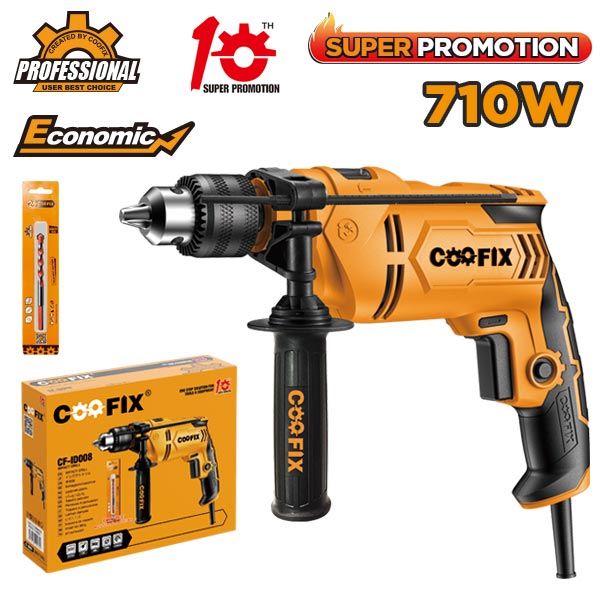
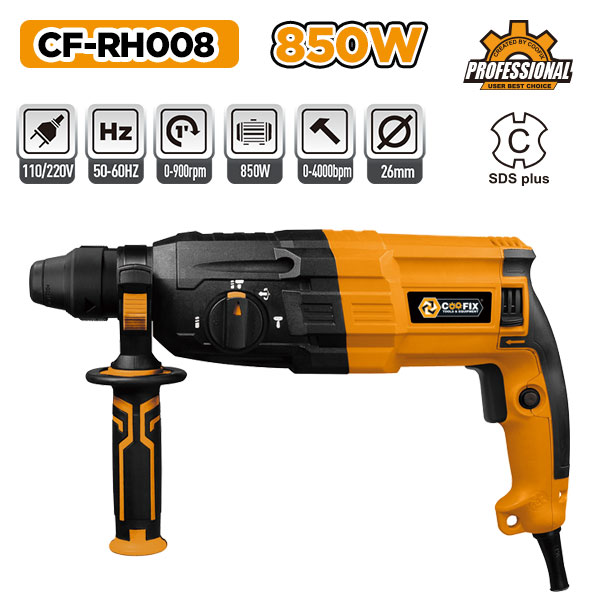
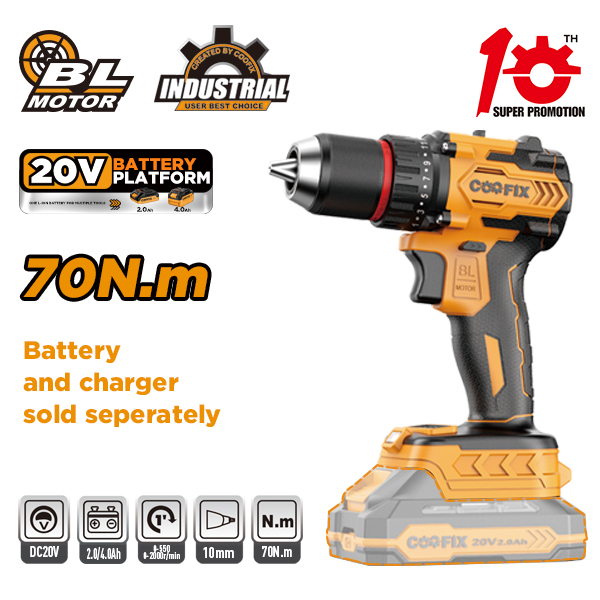
This guide reads those lines on a real sheet. The reference model is the COOFIX CF-ID008, a corded electric impact drill rated 220–240 V / 50–60 Hz with 75 N·m maximum torque, a 0.8–10 mm metal chuck and a published 10 mm drilling capacity in steel; its construction is listed as copper and plastic. The same reading method is then applied to two alternatives from the same range — the CF-CD016 cordless brushless impact drill (20 V, 0–550 / 0–2,000 r/min) and the CF-RH008 rotary hammer (850 W, 26 mm capacity, 0–900 r/min) — so a mains-powered impact drill, a cordless drill and a rotary hammer can be judged on comparable terms.
The models discussed here come from COOFIX, the power tool brand of Jinhua Coofix Tools Co., Ltd., a manufacturer based in Zhejiang, China that exports to Asia, Africa, Eastern Europe, the Middle East and South America. The method is written for buyers who have already shortlisted tools and are moving from evaluation into ordering: distributors building a range, procurement teams checking a quotation, and workshop managers specifying a tool for a defined job.
Why drill spec sheets resist side-by-side comparison
The difficulty is not that sheets are incomplete. It is that they mix three different kinds of number. Input values — voltage, frequency, amps or watts — describe what the tool takes from the supply. Output values — torque and no-load speed — describe what the tool produces at the chuck. Interface and capability values — chuck range and drilling capacity — describe the boundary between the tool and the workpiece. Comparing an input value on one sheet with an output value on another is the most common source of a bad purchasing decision.
Three specific traps follow from that mix:
- Watts read against newton-metres. A higher wattage or amperage figure means more input power, not automatically more torque at the bit. The motor, the gear train and the impact mechanism decide how much of that input reaches the chuck.
- Capacity quoted without a material. “10 mm” is not a complete specification until it says 10 mm in steel, in wood or in concrete. A rotary hammer's 26 mm capacity and a drill's 10 mm steel capacity are not the same measurement, and putting them in one column without a footnote produces a comparison that looks quantitative and means nothing.
- Blank cells read as weakness. Where a value is not published — maximum torque for a cordless model, for example — the honest reading is “not stated”, not “low”. The next step is a request to the supplier, not a downgrade in the shortlist.
Safety standards sit in a separate layer. IEC 62841-2-1:2017 applies to hand-held drills and impact drills with a rated voltage not exceeding 250 V AC/DC, and it sets safety requirements for the tool class rather than a performance ranking between models. The CF-ID008's 220–240 V rating places it inside that voltage scope, which matters for market-access planning but says nothing about how fast the tool will drill a hole.
What changed in the market — and why the reading method still applies
Market estimates explain why today's sheets carry more lines than they did a decade ago. A 2025 commercial research estimate put the global power drill market at USD 15.2 billion in 2023, with cordless models contributing more than 55% of revenue. A separate 2025 market report estimates that lithium-ion batteries account for over 75% of cordless drill batteries sold globally in 2024, and that more than 70% of cordless drill manufacturers are integrating brushless motors. Treat these as third-party estimates with their own definitions, not as measured facts about any single supplier.
For a buyer, the practical consequence is mixed-format comparison. A corded impact drill publishes mains voltage, torque and steel capacity. A cordless model publishes battery voltage, speed ranges and motor type. A rotary hammer publishes wattage, capacity and speed. Two of those three sheets may not publish torque at all. The method below normalises them: pin the job first, then compare only like with like.
The specification lines, read one at a time
1. Voltage and frequency: a market gate, not a power score
The CF-ID008 is rated 220–240 V / 50–60 Hz. Read that as three separate facts. The voltage band says the tool is built for a nominal 220–240 V supply; it is not a 110–120 V tool and should not be planned into a lower-voltage market unless the correct variant is ordered. The 50–60 Hz rating says the same model covers both common supply frequencies. The 240 V upper limit keeps the tool inside the ≤250 V scope of IEC 62841-2-1:2017.
What the line does not tell you is torque, efficiency or build quality. Voltage is the entry condition for a market, not a measure of capability: two tools rated at the same voltage can differ by a factor of two in output torque.
2. Amp draw: what the current rating actually measures
Where a sheet prints amps, it is describing current draw at the rated voltage. Because electrical input power is the product of voltage and current, a higher amp figure at the same voltage generally indicates a higher input power class. That is a statement about the supply side of the tool.
It is not a torque figure. Input power passes through the motor and gearbox, and the proportion that reaches the chuck varies with design, so two tools drawing the same current can deliver quite different torque. Amps are useful for a different job: matching the tool to the supply circuit and to extension leads on site, and comparing tools inside the same input class.
Not every sheet publishes amps. The CF-ID008 values summarised in this guide are the voltage and frequency rating plus the torque rating; if a procurement file needs the current rating, request the rating label or nameplate rather than estimating it from another model's data.
3. Maximum torque: 75 N·m and the weight of the word “maximum”
Torque is rotational force at the output, measured in newton-metres. Maximum torque is the highest figure the tool can produce, and it is normally a peak value rather than a continuous working level. That is why the test basis matters: gear selection, impact mode and how long the tool can hold the figure all affect whether two manufacturers' numbers are comparable. When a sheet does not state the basis, treat the figure as a class indicator rather than a precise ranking.
What 75 N·m changes for a buyer is headroom. Torque headroom determines how large a fastener or bit the tool can turn before it stalls. In mechanical repair that means larger and tighter fasteners; in carpentry it means hole saws and large auger bits in dense timber; in home decoration it means the difference between driving a long screw fully home and stopping halfway. The limit is always conditional on the bit, the material and operator technique — a torque figure is not a promise that every bit of a given size will turn freely.
On cordless models, torque also depends on the battery pack and the selected gear, so a battery drill's torque should be read together with its voltage platform and speed ranges. Where a cordless sheet publishes speed but not torque — as with the CF-CD016 and its 0–550 / 0–2,000 r/min ranges — the correct conclusion is that speed is comparable and torque is not yet documented.
4. Chuck range: 0.8–10 mm decides which bits you can buy
The chuck is the interface, and its clamping range is a hard limit. A 0.8–10 mm metal chuck accepts bits and accessories with shank diameters from 0.8 mm to 10 mm. Below the range, very small bits cannot be gripped reliably; above it, larger shanks simply do not fit.
- The largest shank you plan to use, not the smallest, should drive the purchase decision. Arbors and bits with shanks above 10 mm fall outside this tool's range.
- Hex-shank screwdriver bits are used through a bit holder whose shank sits inside the range, which is how a drill chuck also becomes a fastener driver.
- A metal chuck is specified as metal. That is a material statement about the clamping assembly; it does not by itself grade the jaws, the run-out or the service life.
Chuck range is also the fastest cross-check between a drill and an accessory set. A cordless drill power tool set is only useful if the accessories in the case have shanks inside the tool's clamping range, which is why experienced buyers check case contents against the chuck figure before approving a kit.
5. Drilling capacity: 10 mm in steel is a load rating
Drilling capacity is always material-specific. The CF-ID008 publishes 10 mm in steel. Steel is the demanding case for a drill of this class: it loads the motor and gearbox continuously and leaves little margin for a dull bit.
Read the figure as a drivetrain rating, not as the maximum hole size in every material. The same tool will usually manage larger diameters in softwood, but wood capacity should only be relied on where it is published — otherwise it is an assumption, and removing assumptions is the whole point of reading a specification. No masonry capacity is published for this model, so anchors in brick or concrete belong to a different tool class.
The steel figure also translates directly into application: 10 mm covers clearance holes for small and medium fasteners in brackets, frames and machinery. A fastener whose clearance hole is larger than 10 mm falls outside the published steel capacity, however sharp the bit.
6. Material construction: copper and plastic are families, not grades
The CF-ID008's construction is listed as copper and plastic. Read literally, that identifies the material family of the electrical conductors and of the housing components. It does not disclose winding mass, wire gauge, insulation class, polymer type or flame rating — the details that actually separate two tools with an identical material list.
That makes the material line a question generator rather than a quality score. Ask for the copper winding confirmation, the insulation class, the housing polymer and the quality records attached to the model. COOFIX, for example, describes 100% incoming inspection of raw materials, power-on ageing sampling on semi-finished units, 100% inspection of finished tools for no-load speed, torque and impact performance, and sampling reliability tests — those are the processes that turn a material statement into something auditable.
Decision rule: read the sheet in this order — power source and rated input, then torque (with its basis), then chuck range, then capacity (with its material), then construction materials as open questions. A value that survives all five readings is a specification you can put in a purchase order.
A five-step method for reading any drill sheet before you buy
- Pin the job before you read a number. Record the largest hole diameter, the largest fastener, the material and the duty cycle — occasional or continuous. This decides which specification lines matter at all.
- Read the power line first. Mains voltage and frequency, or battery platform. This gates the destination market and the workflow, because it determines whether the tool needs an outlet.
- Normalise the output values. Torque in newton-metres with its test basis; speed ranges with the gear they belong to. Never compare a peak figure with a continuous one.
- Check the interface limits. Chuck range against the biggest shank in your accessory set; capacity against the material you will actually drill.
- Convert specifications into purchase terms. Model-specific certificates and test records, sample test protocol, MOQ, lead time and warranty. A specification you cannot verify is a negotiation point, not a fact.
Steps one to four take a few minutes on a single sheet. Step five carries most of the commercial risk, because documentation is issued per model and per market rather than per catalogue line — a point developed further below.
Matching the values to the job: decoration, carpentry, repair
Home decoration
The work is mixed and intermittent: fixing shelves and cabinets, drilling pilot holes, setting anchors into plugs, assembling flat-pack furniture, occasionally opening a hole in a metal bracket. A corded impact drill with 75 N·m and 10 mm steel capacity covers all of it, and the 0.8–10 mm chuck spans the small bits used for pilot holes as well as the larger bits used for fixings. The trade-off is the cable: mains power means no runtime limit and no battery platform to manage, but also no working thirty metres from an outlet.
Carpentry
Two lines dominate. Chuck range decides which bit shanks and arbors fit; torque decides whether a hole saw or an auger bit keeps turning in dense timber. Speed is secondary in hardwood and becomes more relevant for clean entry and exit in softwood. Where the timber is not next to an outlet, the cordless format is the one to evaluate — the CF-CD016 publishes two speed ranges, 0–550 and 0–2,000 r/min, which is the comparable data available for that model at present.
Mechanical repair
Steel capacity and torque govern here. 10 mm steel covers bracket, chassis and machinery fastening work, and 75 N·m provides the headroom needed when a fastener has been seated for years. Continuous mains power suits repeated drilling in a workshop, where a cable is not an obstacle. When the task moves to masonry, neither the drill's steel capacity nor its chuck range is the right instrument, and the rotary hammer class — CF-RH008, 850 W, 26 mm capacity, 0–900 r/min — is the appropriate reference.
Reading three sheets side by side
The table below puts the three assigned models on common rows. Where a figure is not published in the specifications available for this guide, the cell says so rather than being filled with an estimate.
| Specification line | CF-ID008 | CF-CD016 | CF-RH008 |
|---|---|---|---|
| Tool class | Corded electric impact drill | Cordless brushless impact drill | Rotary hammer drill |
| Power input | 220–240 V / 50–60 Hz | 20 V battery platform | 850 W |
| Maximum torque | 75 N·m | Not stated in the supplied specification | Not stated in the supplied specification |
| Speed | Not stated in the supplied specification | 0–550 / 0–2,000 r/min | 0–900 r/min |
| Chuck / interface | Metal chuck, 0.8–10 mm | Not stated in the supplied specification | Not stated in the supplied specification |
| Maximum drilling capacity | 10 mm in steel | Not stated in the supplied specification | 26 mm (material basis to be confirmed on the sheet) |
| Construction materials | Copper and plastic | Not stated in the supplied specification | Not stated in the supplied specification |
The table is deliberately incomplete in several cells, and that incompleteness is information. Torque is not published for the CF-CD016 or the CF-RH008 in the specifications used here, and speed is not published for the CF-ID008. Marking those cells “not stated” protects the comparison: a blank is a request for data, not a zero.
The 10 mm and 26 mm capacity figures are not on the same scale. The drill figure is published for steel; rotary hammer capacity is normally quoted on a masonry basis, so the two should only be placed near each other with that difference stated. Power source changes the decision more than any single number: the corded models have no runtime limit but need a supply, while the cordless model trades that constraint for a battery platform, whose capacity and cell configuration are themselves specification items to confirm.
Verifying a specification before you commit
Specification reading ends where documentation begins. Three checks close the gap between a catalogue and a purchase order.
Match the certificate to the exact model and market. Conformity documents are issued per model and per destination market. In COOFIX's certificate records, the EAC certificate covers the CF-CD016 cordless drill, while the CE, LVD and EMC documents cover the CF-RH008 rotary hammer. The CF-ID008 is not named on those particular records, which is normal for per-model certification; the practical step is to request the certificate set that names the model you are ordering, for the market you are selling into.
Ask for the inspection record, not just the claim. Finished-product inspection that covers no-load speed, torque and impact performance is only useful to a buyer when the record for the relevant batch is available. Request it alongside the sampling reliability test documentation.
Test the sample against your own job. Use the same bit, the same material thickness and the same operator, then record how many holes or fasteners the tool completes before it stalls or heats noticeably. A sample tested this way converts a specification line into a decision you can defend.

Frequently asked questions
The CF-ID008 is rated 220–240 V / 50–60 Hz — which markets does that suit?
It suits markets with a nominal 220–240 V supply at 50 or 60 Hz. It is not a 110–120 V tool, so it should not be specified for lower-voltage markets unless the correct variant is ordered. The 240 V upper limit also keeps the model inside the ≤250 V scope of IEC 62841-2-1:2017, the safety standard for hand-held drills and impact drills. Confirm plug type, label language and the model-specific certificate for the destination market before ordering.
Is COOFIX an OEM cordless drill manufacturer?
Yes. COOFIX supports OEM private labeling and ODM appearance and structure customization across corded and cordless tools. The customization scope covers body colour, silk-screen or laser-engraved logos, voltage options of 12 V / 16.8 V / 21 V, battery capacity and cell brand selection, chuck size, impact gears, rotation speed parameters, accessory combinations for the tool case, and colour-box or export-carton design. The brand belongs to Jinhua Coofix Tools Co., Ltd., which reports a monthly production capacity of 300,000 units and an annual output of 2,000,000 units.
How do I compare 75 N·m on a corded drill with a cordless model that publishes only speed?
You cannot compare them directly yet. Torque and speed are different measures: 75 N·m describes rotational force at the output, while 0–550 / 0–2,000 r/min describes how fast the chuck turns in each range. Ask the supplier for the cordless model's maximum torque together with its test basis, then compare torque with torque and speed with speed. Until that figure arrives, the defensible comparison is limited to power source, chuck interface and available documentation.
What does a 0.8–10 mm chuck mean for the bits I can use?
It means bits and accessories with shank diameters from 0.8 mm to 10 mm fit the chuck directly. Larger shanks fall outside the range and require a different tool or holder arrangement, while bits below the 0.8 mm lower limit cannot be clamped reliably. Hex-shank screwdriver bits are used through a bit holder that sits inside the range. Check the largest shank in your accessory set against the 10 mm upper limit before you order.
What MOQ, payment and lead-time terms apply to an order?
Quoted MOQ spans 10 to 500 units depending on the program. Standard orders are quoted from 10 units with a typical 10-day production lead time; private-label programs are quoted at 100–500 units with a 30-day lead time, and ODM appearance and structure customization at 100–500 units with a 60-day lead time. Delivery terms include FOB, CIF and OA, payment terms include T/T, LC and OA, and acceptance is based on pre-shipment testing. Confirm each term against your exact configuration.
How should I validate a sample before a bulk order?
Test it on your own job rather than on a demonstration. Use the same bit, material thickness and operator, then record how many holes or fasteners the tool completes before it stalls or heats noticeably. Request the finished-product inspection record covering no-load speed, torque and impact performance, plus the sampling reliability test documentation. Sample requests and specification questions can be sent to sales@coofixtools.com or +86 13967460577 (WhatsApp and phone).

What to carry into the negotiation
A specification sheet becomes a purchasing tool once it is read in the right order: power source and rated input first, torque with its basis second, chuck range third, capacity with its material fourth, construction materials last and as open questions. Applied to the reference model, the CF-ID008's published set — 220–240 V / 50–60 Hz, 75 N·m maximum torque, a 0.8–10 mm metal chuck and 10 mm steel drilling capacity — is complete enough to specify for home decoration, carpentry and mechanical repair work, provided the certificate that names the model is supplied for the destination market.
Applied to the alternatives, the same order keeps the comparison honest. The CF-CD016 adds cordless mobility on a 20 V platform with two speed ranges; the CF-RH008 adds rotary hammer capacity at 850 W and 26 mm for work the impact drill is not built for. Their unpublished torque figures are data requests, not verdicts — and knowing which cell is empty is the difference between a buyer who compares and a buyer who guesses.
The full COOFIX product catalogue, covering drill, rotary hammer and cordless ranges, can be downloaded here: COOFIX catalogue 2025 (PDF). For model-level specification sheets, certificates that name a specific model and market, or a sample request against your own test protocol, contact the COOFIX team directly.
Have Questions or Need More Details?
Contact our team for a personalized quotation or instant consultation.
Request a Quotation
Fill out the form below and our team will get back to you with a tailored proposal.
WhatsApp Direct Chat
Prefer to chat in real-time? Message us on WhatsApp for instant assistance & quick answers.
- Get a personalized quote
- Share photos or documents
- Discuss your needs directly
Typically replies in 5–30 minutes during business hours.