CF-ID008 vs CF-CD016: Corded vs Cordless Drill Buyer Comparison
Buyer comparison · corded vs cordless electric drill
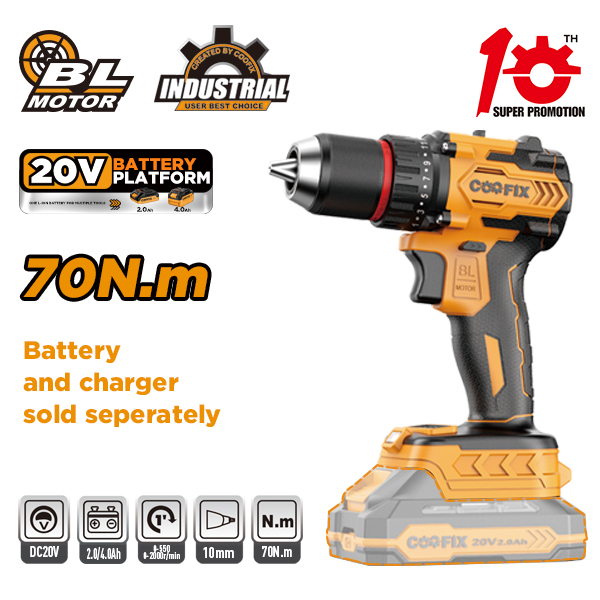
The choice between the COOFIX CF-ID008 and the COOFIX CF-CD016 is settled by power source and duty cycle, not by brand preference or headline wattage. CF-ID008 is a corded electric impact drill rated 220–240 V, 50/60 Hz with 710 W input power and a 0–2800 rpm no-load speed. CF-CD016 is a 20 V cordless brushless impact drill with a 0.8–10 mm metal chuck, 75 N·m maximum torque and two no-load speed ranges, 0–550 and 0–2000 r/min.
For a buyer running a fixed workshop, a bench position or a production line, the corded model removes battery cost and charging downtime. For installation, maintenance and site work where mains power is not guaranteed, the cordless model removes the cable. This comparison sets out what can be verified from the published product data, what is missing and must be requested, and the acceptance criteria to write into a purchase order.
COOFIX is the power tool brand of Jinhua Coofix Tools Co., Ltd., a manufacturer founded in 2014 and based in Yongkang, Zhejiang, China, producing power tools, garden tools, hand tools and accessories for export markets.
The buyer problem: two specification sheets that do not share a unit
A corded electric drill is rated by mains input power in watts. A cordless drill is rated by battery voltage, motor type and torque at the chuck. Setting “710 W” against “20 V” answers no question a buyer actually has, because the two numbers describe different things: the corded figure describes power drawn from the mains, and the cordless figure describes the battery platform that feeds the motor.
Five practical gaps appear when the two COOFIX models are put side by side on paper:
- Torque is documented for one model only. CF-CD016 is published at 75 N·m maximum torque. No maximum torque figure for CF-ID008 appears in the available product data.
- Drilling capacity is stated on different bases. CF-ID008 is listed with a maximum drilling capacity of 13 mm. CF-CD016 is listed with 10 mm drilling capacity in steel. A capacity figure without a stated material is not directly comparable with one that names steel.
- Chuck range is documented for one model only. CF-CD016 carries a 0.8–10 mm metal chuck. No chuck tightening range for CF-ID008 is given in the available data.
- Certification evidence is model-specific. A certificate that names one model does not automatically cover another model in the same catalogue.
- Commercial terms move with the configuration. Kit composition, minimum order quantity and lead time change by customization mode, so a single unit price is not a reliable comparison.
Decision rule: choose the power source from the duty cycle and the site power supply first; then confirm torque, chuck range and model-level certification for the exact SKU; then settle MOQ, lead time and warranty in writing.
Industry background: why cordless dominates and why corded still ships
The global power drill market reached USD 15.2 billion in 2023, and cordless drills contributed over 55% of that revenue, according to Strategic Market Research. Two supply-side shifts explain the direction of travel. Lithium-ion batteries account for over 75% of all cordless drill batteries sold globally in 2024, based on commercial research published by Cognitive Market Research, and over 70% of cordless drill manufacturers were integrating brushless motors in 2025 to improve tool efficiency.
Cordless dominance does not remove the case for a corded tool. Battery platforms introduce items a buyer must stock and warranty — cells, packs and chargers — while a mains-powered tool introduces a dependency on site power and a cable. For buyers distributing into markets where site power is reliable but battery service networks are thin, a corded model in the range is a practical counterweight rather than a legacy item.
On the regulatory side, IEC 62841-2-1:2017 is the particular safety standard for hand-held drills and impact drills with rated voltage up to 250 V AC/DC. Both models sit inside that parameter band — 220–240 V AC for CF-ID008 and 20 V DC for CF-CD016 — which is why buyers normally ask for drill safety documentation rather than assuming that the presence of a certificate for a different power tool in the same catalogue also covers drills.
CF-ID008: corded electric impact drill specifications
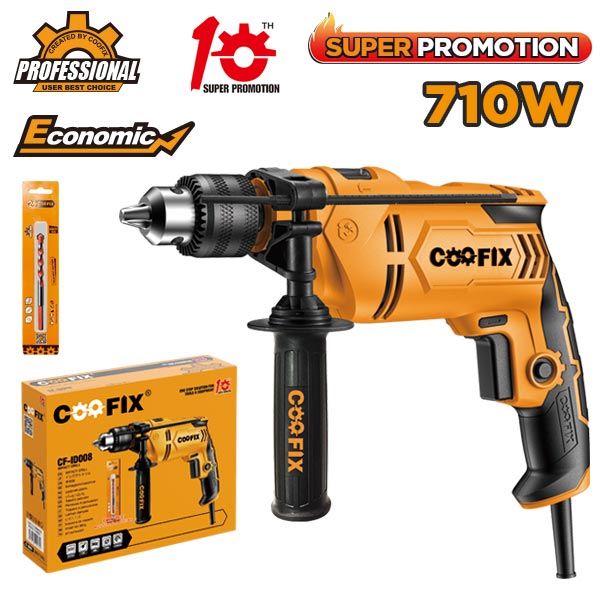
CF-ID008 is a corded electric impact drill built from copper and plastic. Its published specification is:
- Rated voltage: 220–240 V ~ 50/60 Hz
- Input power: 710 W
- No-load speed: 0–2800 rpm
- Maximum drilling capacity: 13 mm
- Stated applications: home decoration, carpentry, mechanical repair
The operational advantage is continuity. Because the tool draws from the mains, output does not fall away as a pack discharges, and there is no charger, no pack inventory and no battery warranty exposure. That matters in bench work, workshop assembly and repair bays where the tool stays within reach of a socket and runs for extended periods.
The constraints are equally concrete. The tool is unusable where mains power is unavailable or unstable, the cable limits movement around a site, and the 220–240 V / 50 Hz specification fixes the destination markets the model suits. Two specification fields are also missing from the available data and should be requested before a purchase order is raised: maximum torque, and the material basis of the 13 mm drilling capacity figure.
CF-CD016: cordless brushless impact drill specifications
CF-CD016 is a 20 V cordless brushless impact drill, also built from copper and plastic, and it is listed in COOFIX application data for construction and home decoration work. Its published specification is:
- Rated voltage: 20 V
- No-load speed: 0–550 / 0–2000 r/min (two ranges)
- Maximum torque: 75 N·m
- Chuck tightening range: 0.8–10 mm, metal chuck
- Drilling capacity in steel: 10 mm
The two speed ranges give the operator a low range for controlled starts and a high range for faster drilling, and 75 N·m is the only published torque figure in this comparison. Because the motor is brushless, the maintenance item that normally consumes brushes is removed from the service schedule — a detail that matters to distributors who carry spare parts obligations. The metal chuck is specified across a 0.8–10 mm tightening range, which defines the accessory inventory the tool can accept.
The constraints sit on the battery side. Pack capacity, cell brand, runtime and charge time are not published in the available product data, and the tool is only as available as its charged packs. For the Eurasian Economic Union market, CF-CD016 is covered by EAC certification number ЕАЭС KG417/046.CN.02.07167, issued by ОС «Центр сертификации «Мурас» under standards ТР ТС 010/2011 and ТР ТС 020/2011, issued on 7 July 2025 and valid to 6 July 2030.
Power source trade-offs that change cost of ownership
The purchase price of a cordless drill covers more than the tool, while the purchase price of a corded drill covers less. Buyers comparing the two should model the difference on these four lines:
- Energy and consumables. A corded tool consumes mains electricity and no packs. A cordless tool consumes packs and charger cycles, and COOFIX lists a 12-month warranty for lithium batteries and chargers against a 1-year warranty for the complete machine.
- Site readiness. A corded tool needs a compliant power supply at the work position. A cordless tool needs a charging routine and spare packs if the work is continuous.
- Service exposure. Spare wearing parts are supplied in bulk for both models, and the brushless motor in CF-CD016 removes the brush replacement line from the after-sales budget.
- Kit scope. Custom accessory combinations are available for the tool case, including drill bits, screwdriver bits and the quantity of chargers, so “tool only” and “kit” configurations are not the same product commercially.
Chuck, bit range and supporting equipment
A drill is only as capable as the bits it can hold. The CF-CD016 metal chuck tightens across 0.8–10 mm, so any bit within that shank range fits; a bit with a larger shank needs a different tool or an adaptor, and that has to be planned before the accessory order is placed. For CF-ID008, the chuck tightening range is not stated in the available data, so the bit inventory should be confirmed with the supplier rather than assumed to match the cordless model.
Drill bits are the matched equipment listed for both models across the application data, and the practical buying consequence is that accessory specification belongs in the same request as the tool. Buyers building a cordless drill power tool set should also note that COOFIX customization data lists 12 V, 16.8 V and 21 V voltage options across cordless models, while the CF-CD016 sheet states 20 V. A 21 V drill tool kit configuration and a CF-CD016 order are therefore separate specifications, and the exact voltage, pack capacity and cell brand must be fixed in the RFQ rather than inferred from the platform name.
Step-by-step evaluation sequence for buyers
- Define the duty cycle. Decide whether the tool runs continuously from a fixed position or intermittently across locations. Continuous duty favours the corded CF-ID008; intermittent, cable-free work favours the cordless CF-CD016.
- Check the power supply at the work position. Confirm voltage and frequency availability for 220–240 V / 50 Hz equipment, or confirm charging capacity and spare pack policy for a 20 V platform.
- Match the chuck range to the bit inventory. Compare the 0.8–10 mm tightening range of the CF-CD016 metal chuck with the bits already stocked or planned, and request the equivalent figure for CF-ID008.
- Put drilling capacity on a common basis. Use 10 mm in steel for CF-CD016 and ask the supplier to confirm the material basis of the 13 mm maximum figure for CF-ID008 before treating the two as comparable.
- Verify certification at model level. Request the certificate that names the exact model, with certificate number, issuing body, applicable standard and validity dates.
- Fix the commercial terms. Confirm MOQ, lead time, kit composition, warranty, spare parts list and packaging artwork in the purchase order.
Application fit by scenario
COOFIX application data lists both CF-ID008 and CF-CD016 for home decoration, carpentry, mechanical repair and maintenance and repair service work, which means the choice inside those scenarios is driven by access to power rather than by task type. Two scenarios separate the models more sharply:
- Construction and interior fit-out. CF-CD016 is listed for construction and home decoration work, including drilling for fixing screws, opening pipe routes, installing doors, ceilings, hanging cabinets and light steel keels. Cable-free operation matters where a site is still without energised circuits.
- Workshop, production line and repair bay. CF-ID008 suits fixed positions — bench assembly, equipment maintenance and repetitive repair work — where mains power is present and continuous running is normal.
One boundary should be stated clearly to avoid mis-selling: CF-CD016 is a cordless brushless impact drill, not a rotary hammer. Heavier drilling in concrete belongs to a different tool class in the range, such as the CF-RH008 rotary hammer with a 26 mm drill capacity, 850 W rated input power and 0–900 r/min no-load speed. Buyers looking for a cordless hammer drill platform should specify that requirement separately rather than substituting an impact drill.
Comparison table: CF-ID008 vs CF-CD016
| Attribute | CF-ID008 | CF-CD016 |
|---|---|---|
| Product type | Corded electric impact drill | Cordless brushless impact drill |
| Power source | 220–240 V ~ 50/60 Hz mains | 20 V battery platform, charger required |
| Input power | 710 W | Not applicable — battery powered |
| No-load speed | 0–2800 rpm | 0–550 / 0–2000 r/min (two ranges) |
| Maximum torque | Not stated in available product data | 75 N·m |
| Chuck | Not stated in available product data | 0.8–10 mm metal chuck |
| Drilling capacity | 13 mm maximum | 10 mm in steel |
| Housing materials | Copper, plastic | Copper, plastic |
| Stated applications | Home decoration, carpentry, mechanical repair | Construction, home decoration, carpentry, mechanical repair |
| Certification named in available data | AEO certificate 096099139001 (customs-compliance credential; CF-ID008 listed among covered products) | EAC ЕАЭС KG417/046.CN.02.07167, valid to 6 July 2030 |
| Battery and charger in scope | No | Yes — confirm kit composition and 12-month battery/charger warranty |
The table also shows what it cannot show: no weight, runtime, charge time, vibration or noise value is published for either model in the available data, so any claim made on those dimensions should come from the supplier in writing rather than from assumption.
Purchasing terms, quality control and acceptance criteria
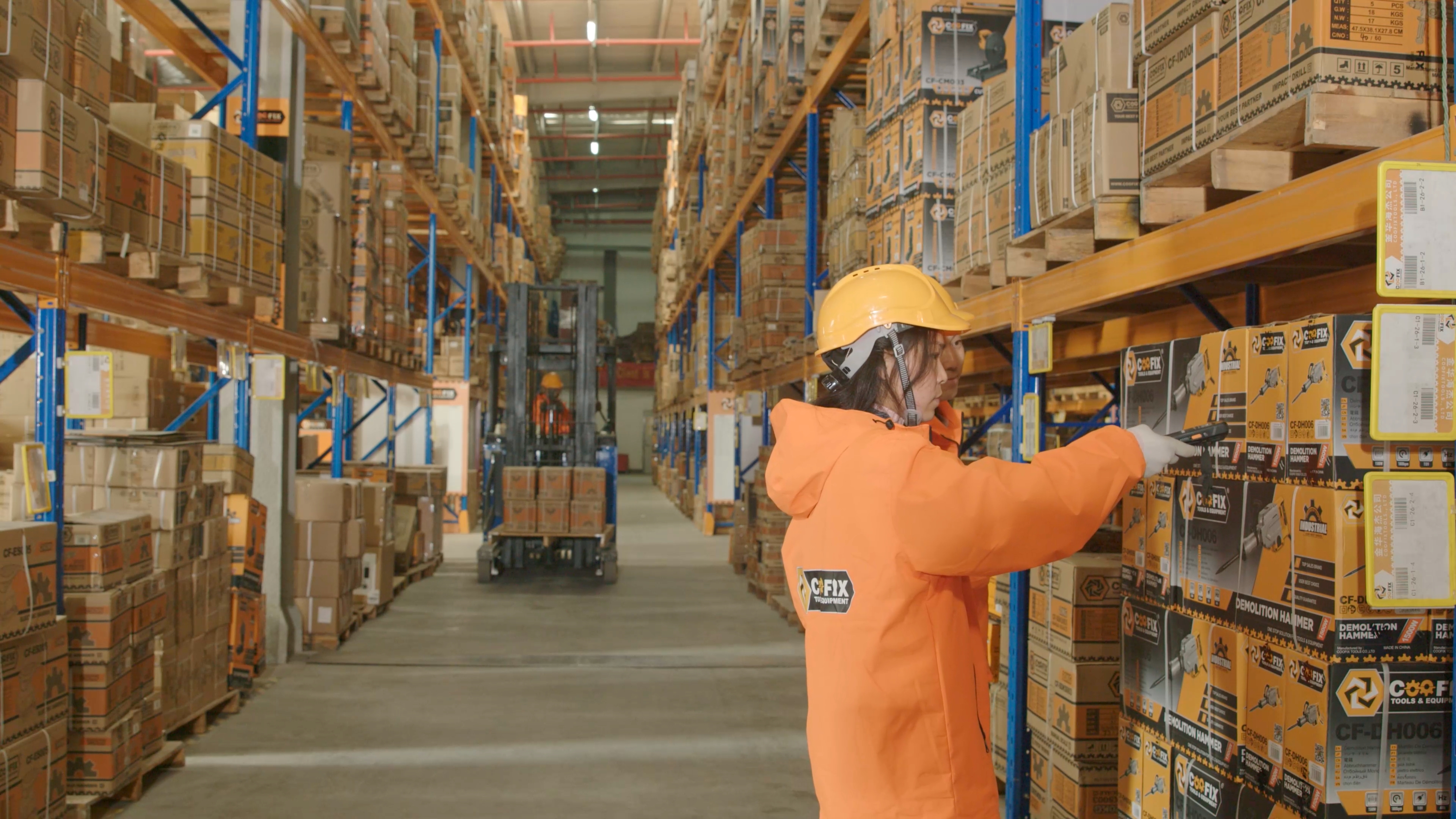
Commercial terms for the two models are configuration-driven rather than model-driven. COOFIX capability data lists a minimum order quantity of 10 units for one OEM and customized configuration, and 100–500 units for private labelling and ODM appearance and structural customization. Lead times are listed as 10 days, 30 days and 60 days depending on the configuration selected. Production capacity is stated at 300,000 units per month and an annual output of 2,000,000 units, with daily shipping capacity of over five 40HQ high-cube containers.
Quality control is defined in four stages: 100% incoming inspection for raw materials; power-on aging sampling inspection for semi-finished products on the production line; 100% full inspection of finished goods for no-load speed, torque and impact performance; and sampling reliability testing. After-sales terms list a 1-year warranty for the complete machine, a 12-month warranty for lithium batteries and chargers, bulk supply of spare wearing parts, remote technical guidance and fault troubleshooting for overseas clients, on-site engineer technical support for bulk orders, and reshipment of damaged goods with claim assistance for logistics damage.
Delivery records give a view of what those controls produce in the field. COOFIX case records for overseas hardware brand distributors report a rework rate kept below 1.1% with a repeat purchase rate above 80%, and case records for offline building material chain supermarkets report a rework rate controlled below 1.5% with a repeat purchase rate above 70%.
Acceptance criteria to write into the purchase order
- Model number CF-ID008 or CF-CD016 printed on the nameplate, the colour box and the export carton, matching the approved artwork.
- Rated voltage and frequency stated on the tool and the packaging: 220–240 V ~ 50/60 Hz for CF-ID008; 20 V for CF-CD016.
- No-load speed verified against specification, including both the 0–550 and 0–2000 r/min ranges on CF-CD016.
- Torque and impact performance checked under the supplier's 100% finished-goods inspection, with the sampling record supplied.
- Chuck function tested at the ends of the 0.8–10 mm range on CF-CD016, with the matching chuck figure confirmed in writing for CF-ID008.
- Certification documents attached at model level: EAC certificate number and validity for CF-CD016; AEO certificate number 096099139001 for the shipment documentation where applicable.
- Kit content listed line by line: tool, battery quantity, charger quantity, drill bits, screwdriver bits, case.
- Warranty terms in writing: 1 year complete machine; 12 months lithium battery and charger.
- Spare wearing parts list and bulk supply arrangement confirmed before first shipment.
Frequently asked questions
Which certifications apply to the CF-ID008 and CF-CD016 electric drills?
Certification evidence differs by model and must be checked item by item. In COOFIX documentation, the cordless drill CF-CD016 is covered by EAC certification number ЕАЭС KG417/046.CN.02.07167, issued by ОС «Центр сертификации «Мурас» for the Eurasian Economic Union market under standards ТР ТС 010/2011 and ТР ТС 020/2011, valid from 7 July 2025 to 6 July 2030. CF-ID008 is listed among the products covered by AEO certificate 096099139001, issued by Hangzhou Customs of the People's Republic of China under the WCO SAFE Framework, valid from 23 December 2025 to 22 December 2030. AEO is a customs-compliance credential for import and export operations, not a product safety mark, so it should not be presented to a distributor as a substitute for product conformity documentation.
How does a buyer confirm that CE documentation covers the exact drill being purchased?
A CE certificate is only valid for the models named in its scope, so the check is textual. COOFIX CE documentation in the available records names specific products: the angle grinder CF-AG012 under certificate ICR Polska/VC/HF220401 issued by ICR Polska Co. Ltd. to standard EN 62841-2-3:2021+A11:2021, valid from 1 April 2022 to 31 March 2027; and the rotary hammer CF-RH008 under certificate ZHT-241218138S02C issued by Guangdong Zhongshan Testing Technology Co., Ltd. (ZHT Lab) to standards EN IEC 62841-2-6:2020+A11:2020 and EN 62841-1:2015+A11:2022, valid from 2 December 2024 to 1 December 2029. Neither of those documents names a drill model. When sourcing from CE-certified electric drill manufacturers, ask for a certificate that states the drill model, the certificate number, the issuing body, the applicable standard and the expiry date, and treat IEC 62841-2-1:2017 as the reference standard for hand-held drills and impact drills rated up to 250 V AC/DC.
Is CF-CD016 a brushless cordless drill, and what does the brushless motor change for buyers?
Yes. CF-CD016 is specified as a cordless brushless impact drill rated 20 V, with two no-load speed ranges of 0–550 and 0–2000 r/min, 75 N·m maximum torque, a 0.8–10 mm metal chuck and 10 mm drilling capacity in steel. The brushless motor removes brush replacement from the service schedule, which reduces the spare-parts line a distributor has to carry; brushless adoption is also the direction of the category, with over 70% of cordless drill manufacturers integrating brushless motors in 2025. What the available data does not state is runtime, charge time or pack capacity, so those figures must be requested for the specific battery configuration being ordered.
How should a buyer compare budget between a corded and a cordless model?
No unit price, FOB price or MOQ-linked price is published in the available product data for either model, so a like-for-like comparison has to be built from the cost drivers. For CF-CD016 those drivers are the battery pack, the charger, the 12-month battery and charger warranty, and the kit configuration; for CF-ID008 they are the tool, the cable and plug specification for 220–240 V / 50 Hz markets, and no battery inventory. Both models share the 1-year complete machine warranty and the bulk spare wearing parts arrangement. The practical approach is to request quotations on identical scope — tool only versus full kit, stated battery capacity and cell brand, stated packaging — so that the comparison is made on the same commercial basis.
Can buyers order samples, and what lead time applies?
Sampling is supported through the standard order process. COOFIX capability data lists a minimum order quantity of 10 units for one OEM and customized configuration, with 100–500 units for private labelling and ODM appearance and structural customization, and lead times of 10 days, 30 days and 60 days depending on the configuration selected. Buyers evaluating CF-ID008 against CF-CD016 should confirm the exact configuration in writing before the sample request, because voltage platform, pack capacity, chuck setting and case accessories all change the specification. Requests can be sent to sales@coofixtools.com or via WhatsApp on +86 13967460577, and the full range is listed in the COOFIX 2025 product catalogue.
Conclusion: pick the power source first, then verify the specification
The corded CF-ID008 is the stronger choice where mains power is available and the tool runs continuously: 220–240 V, 710 W, 0–2800 rpm and a 13 mm maximum drilling capacity, with no battery inventory and no charging cycle. The cordless CF-CD016 is the stronger choice where the work moves and power does not: 20 V, brushless motor, two speed ranges, 75 N·m maximum torque, a 0.8–10 mm metal chuck and 10 mm capacity in steel, backed by EAC certification for the Eurasian Economic Union market.
What separates a good purchasing decision from a fast one is documentation discipline. Torque and chuck range are not stated for CF-ID008 in the available data; certification scope is model-specific for both tools; and MOQ and lead time move with the configuration. A buyer who confirms those four points in writing before the first order avoids the most common rework in this category — receiving a correctly built tool against an incorrectly specified requirement.

Request a sample, quotation or the 2025 catalogue
COOFIX supplies corded and cordless electric drills to distributors, importers and private-label brand owners across Asia, Africa, Eastern Europe, the Middle East and South America, with OEM and ODM customization available on body colour, logo, voltage platform, battery configuration and tool-case accessories.
Email sales@coofixtools.com · WhatsApp +86 13967460577 · www.coofix-tools.com · Download the COOFIX 2025 catalogue (PDF)
Have Questions or Need More Details?
Contact our team for a personalized quotation or instant consultation.
Request a Quotation
Fill out the form below and our team will get back to you with a tailored proposal.
WhatsApp Direct Chat
Prefer to chat in real-time? Message us on WhatsApp for instant assistance & quick answers.
- Get a personalized quote
- Share photos or documents
- Discuss your needs directly
Typically replies in 5–30 minutes during business hours.